
From News Desk
Gartner IT Symposium/Xpo has taken place in Cochin. Below is a collection of the key announcements and insights coming out of the conference.
On Day 3 from the conference, discussions involve how organisations can unlock value from AI agents and multiagent systems, revealing Gartner’s top strategic predictions for 2027 and beyond; and highlighting the top data and analytics trends shaping the future of business.
Key Announcements
Gartner Forecasts India IT Spending to Grow 10.6% in 2027
Gartner Identifies the Top Strategic Technology Trends in Software Engineering for 2026 and Beyond
Decision Intelligence: Getting Value from AI Agents and Multiagent Systems
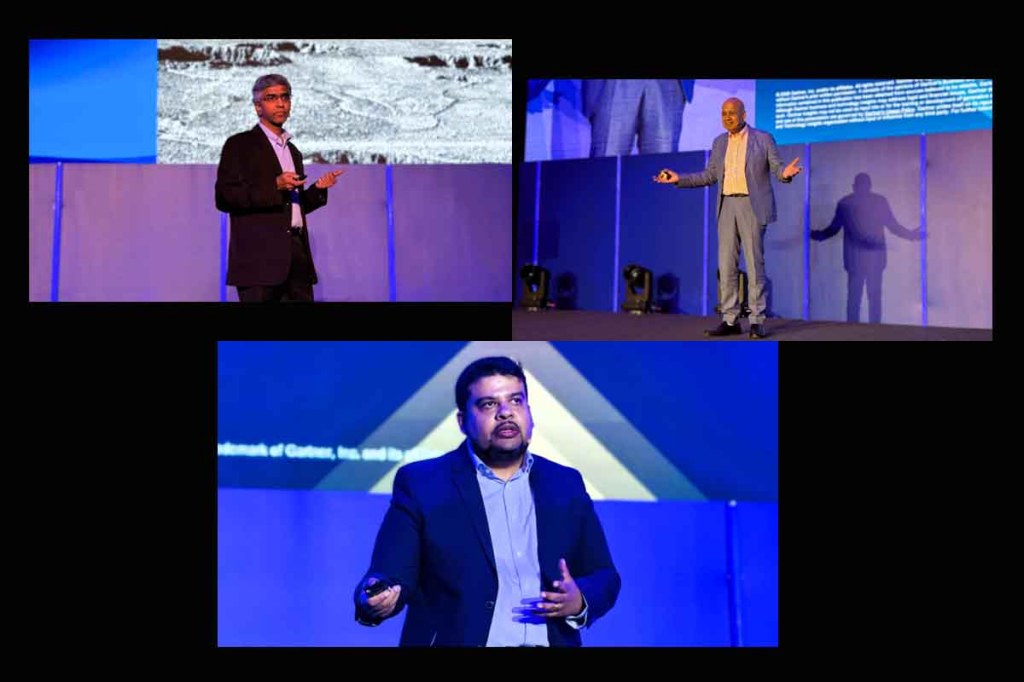
Presented by Arun Chandrasekaran, Distinguished VP Analyst, Gartner
The AI operation phase is giving way to the next evolution of AI software, driven by composite AI and AI agents. In this session, Arun Chandrasekaran, Distinguished VP Analyst at Gartner, explored how organisations can build adaptable and resilient systems using the discipline of decision intelligence to maximise the value and impact of the emerging AI agent wave.
Key Takeaways
–“Organisations must use decision intelligence as a design principle for AI agent orchestration, ensuring decisions are engineered, evaluated and continuously improved through feedback.”
–“Beware of market hype around AI agents that may lead to sterile AI investments without clear business value.”
–“Identify use cases where AI agents can create meaningful impact based on their unique capabilities, including decision support, augmentation and automation.”
–“Organisations must implement a comprehensive AI literacy program as the deployment of AI agents implies a deeper understanding of composite AI techniques.”
–“Prepare for the next evolution of AI agents by exploring software simulation environments to test, refine and optimise agent behaviors before deployment.”
Signature Series: Top Strategic Predictions for 2027 and Beyond
Presented by Milind Govekar, Distinguished VP Analyst, Gartner
As AI reshapes the systems we rely on, successful organisations will balance innovation with responsibility to manage both the opportunities and unintended consequences of an AI-driven world. In this session, Milind Govekar, Distinguished VP Analyst at Gartner, unveiled the top strategic predictions of the future that represent opportunities or threats.
Key Takeaways
–By 2029, 60% of organisations deploying AI will establish a dedicated function responsible for mapping AI total cost to value or profit. “Organisations should link token usage directly to business value metrics, while implementing clear governance, quotas and monitoring controls to ensure AI investments deliver measurable returns.”
–By 2029, 80% of new applications will be intentionally disposable – used for less than one year – revolutionizing the software lifecycle. “AI is making application development so accessible that employees will increasingly create temporary applications to meet short-term business needs.
–By 2030, 80% of front-line workers employed by international companies will be assisted by physical AI systems. “Technologies such as robots, drones, autonomous vehicles and other embodied systems will sense, interact with and influence their surroundings.”
–By 2030, 80 percent of organisations with public-facing AI will have experienced a cost exhaustion attack creating excessive AI cost. “Make AI token costs a cybersecurity indicator, implement cost-focused security controls, and extend monitoring capabilities across all AI technologies.”
Top Data and Analytics Trends 2026
Presented by Sharat Menon, Senior Director Analyst, Gartner
AI agent adoption transforms data and analytics (D&A) strategy and operations. In this session, Sharat Menon, Senior Director Analyst at Gartner, examined the top trends across three key viz., agentic D&A, semantics at the core and D&A platform.
Key Takeaways
–“By 2030, more than one in 10 enterprises will be AI-first, achieving competitive advantage by integrating AI agents, semantics and converged D&A platforms into core business operations.”
–“Agentic D&A is the next wave in optimizing the data-to-impact lifecycle. By integrating AI agents wherever scarce resources are used, organisations maximize business value through responsive D&A operations.”
–“Semantics at the core enables the AI-first enterprise by establishing the standardised, contextual foundation necessary to connect fragmented data and metadata silos. This creates the reliable structure required for AI agents to scale and drive the best business outcomes.”
–“D&A platformisation is a technology rationalisation process that replaces disconnected, single-purpose data and analytics tools with converged platforms to simplify architectures, standardize operations and reduce technical handoffs across teams and systems.”
–“Converged data, analytics and AI platforms simplify the complex operations that have traditionally slowed down D&A teams, making it easier for them to become AI-first faster.”

