
From Opinions Desk
India and Japan are working towards cooperation in several sectors, from technology to defence. As New Delhi and Tokyo make efforts to combine Japan’s leadership in hardware with India’s startup energy, challenges still remain.
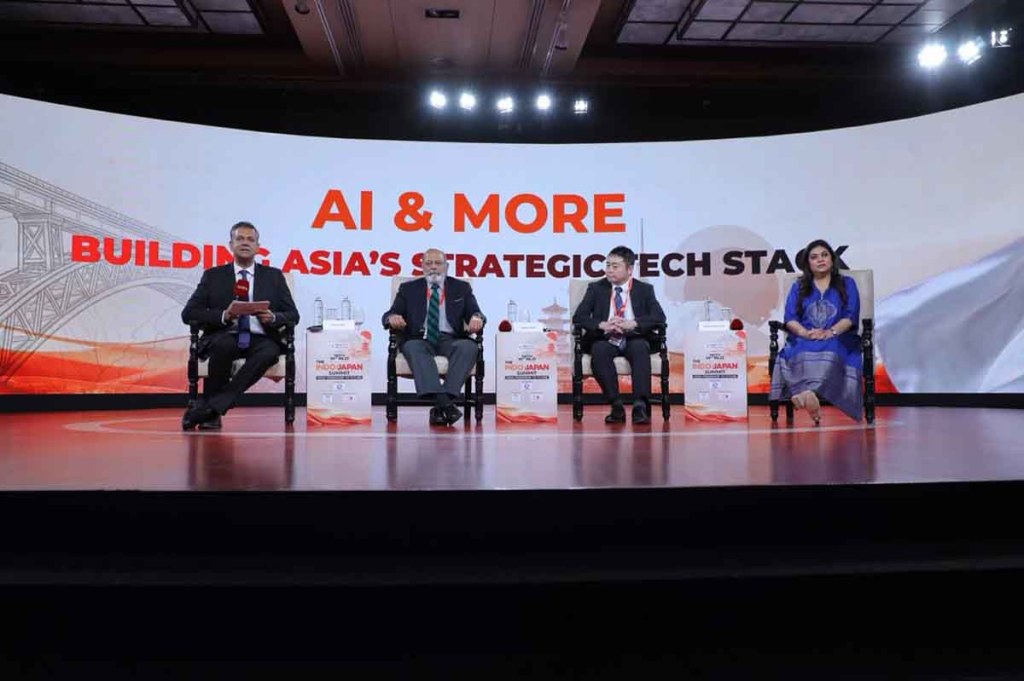
Speaking at the Indo-Japan Summit, Sujan Chinoy, the former Indian ambassador to Japan, said that trusted partnerships and secure global supply chains were the need of the hour for countries with limited geography such as Japan.
He explained that the idea applied to sectors like AI and semiconductors as well, adding that India could be a good partner.
“I think unless India and Japan were to work together, it would be virtually impossible to create a trusted strategic technology stack for Asia,” the former envoy said.
Digital And AI-Related Services Crucial
Daisaku Yukita, the Chief Director General, JETRO, New Delhi, echoed the statement and mentioned that digital and innovation-related services, such as AI and deep tech, will be relationship drivers as far as business between India and Japan is concerned. He said that the complexity of challenges today requires collaboration among entrepreneurs, industry leaders and other sectors.
“Japan has quite a large potential. India offers a rapidly growing ecosystem, and at the same time, Japan offers worldwide technologies and manufacturing capabilities. So, when these strengths meet, the potential is huge,” Daisaku Yukita said.
Shweta Rajpal Kohli, President and CEO, Startup Policy Forum, said that there was immense interest in both Japan and India for deepening collaboration.
She mentioned that as countries like India and Japan try to build out their sovereign tech capabilities, plenty of questions will arise about how they build out those stacks.
Challenges Still Remain
Ambassador Chinoy said when it comes to dual-use technologies such as AI, policy or regulatory bottlenecks are still present. There is a need to harmonise regulatory frameworks, for which conversations are needed on an ongoing basis, he said. “The second challenge is that India’s AI mission is largely public sector driven, whereas Japan’s AI is largely private sector driven. So where shall the twain meet?” he added. Getting 500 Indian AI professionals to go to Japan when there is higher compensation available in countries like the US is also tough, he mentioned. “We should be working together on the creation of semiconductor supply chains and full stack, which includes data centres; it also obviously includes GPU computing,” he added.
Daisaku Yukita stated that for manufacturing semiconductors, the main requirement is a reliable ecosystem. He said that companies across the globe are facing challenges in this sector, and the key thing is to listen to those challenges and create a business-friendly environment.
Shweta Rajpal Kohli stated that collaboration between India and Japan is “just the beginning of a very very exciting partnership.” She stated that any collaboration had immense potential because “it’s complimentary”. “Japan is known for its advanced manufacturing, and it is where the raw materials lie. India has those gaps in the supply chain, and it has the design talent,” she added.
All the panelists expressed hope that Japan and India can be partners beyond their current ties.

