
From News Desk
Community-led project in the Yasawa Islands offers a new model for locally driven renewable energy and water infrastructure.
The Land Art Generator Initiative (LAGI) and the Village of Marou have announced that “The O,” designed by Italian-born, Denmark-based architect Alberto Roncelli, will advance to full-scale construction in Marou Village following the conclusion of LAGI 2025 Fiji’s two-stage competition process.
The selection marks the culmination of a global design competition that drew 205 submissions from 45 countries and was made possible by the support of the Sergey Brin Family Foundation.
“The O” by Alberto Roncelli and “Ligavatuvuce” by Young Kang were both named Stage 1 winners in June 2025, each receiving USD 100,000 to develop functioning prototypes. Both of these prototypes are currently on display to the public at the Fiji Arts Council in Suva through May of 2026. Their fabrication offered an opportunity to assess the two finalists against a set of criteria that included technical feasibility, cultural resonance, economic opportunity, and replicability.
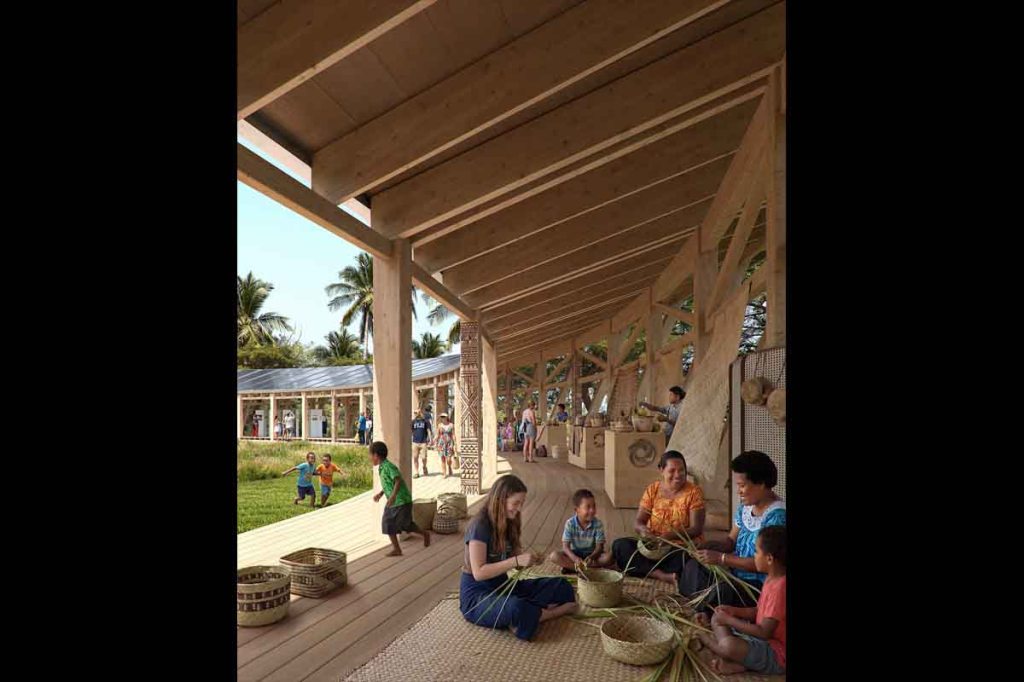
Shaped as a perfect circle 40 meters in diameter, “The O” is a timber-canopied solar pavilion that integrates photovoltaic energy generation, rainwater harvesting and a flexible public gathering space. The installation is designed to produce 150 MWh of electricity and 1.2 million liters of filtered water annually — directly addressing the electricity and potable water needs of Marou Village’s 67 households. The hand carved beam on the prototype is by local Fijian artist Sonny from Yanuyanu Art and represents the symbols of Marou Village.
In a statement Alberto Roncelli wrote, “Over the past nine months, meeting and working with the people of Marou has been a highlight of this project. Being on-site with the community allowed us to better understand the land, gather essential feedback, and implement design improvements already visible in the 1:1 prototype built in Suva. I’m incredibly excited to take the next steps alongside the village and all our project collaborators to realize “The O” together, demonstrating what’s possible for sustainable infrastructure across the Pacific.”
Ilisari Naqau Nasau, Acting Chief of Marou Village, spoke to Elizabeth Monoian and Robert Ferry about what the project means to Marou. “I remember the day we met and you explained the purpose of your visit,” he said. “I knew it was me you had been searching for. And I knew that it was you I was searching for. The previous Chief — my uncle — had just passed away. I was standing where I am today. Please do not take it lightly. Take it with a heart like my heart, loving and for my people.”
He sees the project as something larger than a single structure. “What we are building in Marou together is a signal to our children that their village is a place where the world comes to learn,” he said. “When this is built, I want every person who visits to understand that this community has always known how to live well with this land.”
“From the very first workshops with Marou Village, we knew this project would be unlike anything we had done before,” said Elizabeth Monoian, LAGI co-founder. “There were unexpected delays during prototyping, but Loma Mataika, Fiji-based architect and founder of Atelier153, brought exactly the expertise and deep knowledge that the project demanded. Because of her leadership, the prototypes were ready for the stakeholder review, and the community’s response made clear that both designs had genuinely listened to Marou.”

